|
In
the middle of the second half of the century the Dalmatian
agriculture, mainly viticulture, stretches to significant
dimensions with an accent on increased exporting .
A formed agricultural administration, expert services,
beginning of education and a fortified economy create
the conditions and make their request that for the
Dalmatian region be established a scientific agricultural
institution that would be concerned with scientific
questions in regards to agricultural development of
this region. In agreement to such a valid request,
regarding the institution, the Ministry of Agriculture
in Vienna with its decree of July 1, 1894 established
the C.K. CHEMICAL - ECONOMIC TESTING INSTITUTE IN
SPLIT. On July 15th in 1895, the institute received
its first Statute.
The
Institute was placed in the rooms of a telegraph office
in the today Marmontova street. In 1896 the Institute
in its possession had a library of 4000 books in the
field and was receiving 50 magazines.
On
the 8th of October 1905 was established a school in
the framework of the Institute which by the Statute
of the same year was named C.K. AGRICULTURAL SCHOOL
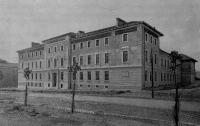
AND TEST CENTER IN SPLIT. To accommodate the needs
of the new establishment was erected a large new three
story building in 1907 in Split's present day Frankopanska
11 street.
This
is how, envisioned and with given conditions at the
beginning of the century in Dalmatia, was created
a modern complex for scientific research and a learning
canter capable of executing significant influence
on the development of economy of this region. With
analytical work on quality control of food products,
(primarily wine and oil) kept were statistics on the
components and quality of wine. Experimental work
was carried out concerning problems and production
needs. This is the period of sudden decline of wine
growing due to phylloxera, but also an intense period
of renewal of Dalmatian wine growing on American foundations,
which is best illustrated by the fact that in the
period between 1905 and 1910 was out up 15 000 acres
of vineyards.
The
period between two world wars was particulary rough
for the Institute. Underestimations of the oldest
agricultural scientific institute, in Yugoslavia of
that time, were not just a reflection of ignorance
concerning the specificity of agriculture in the Adriatic
region, but a reflection of the political orientation
of the central government in Belgrade that systematically
neglected the economy in the coastal regions. Despite
dificulties, new departments were founded within the
Institute: entomological (1925), phytopathological
(1929), pedological (1929) and agrobotanical (1930).
After
the 2nd world war and after overcoming the first hardships
the station started to focus more on its initial tasks,
it reinforced itself with expert and scientific staff,
regrouped and spread into Kastel Stari with its objects
for olive growing and fruit farming, while in Kastel
Luksic it went ahead with viticulture and vegetable
farming. At this time was accepted that the Adriatic
coastal region with its ecological characteristics
was significantly different from the remaining parts
of the country, and as a result the problems of agricultural
production are specific and demand individual research
and answers. Besides that, this region with a surface
area of 30 000 square kilometres in its entirety lies
connected to the Adriatic rocky terrain, which with
its phenomenon gives a main description to the agriculture
and forestry of this region.
Because
of the mentioned reasons or increase in the activity
concerning erosion and improvement, the district Assembly
in Split brought a decision 03-12367 on 24.8. 1964
concerning the change in the name of the INSTITUTE
FOR ADRIATIC CROPS AND KARST RECLAMATION. In 1964
on location in Duilovo-Split a new office building
was erected providing an adequate 2500 square meters
for laboratory and other types of activity.
The
INSTITUTE on its developmental path, in a variety
of forms and intensity had nurtured the educational
activity. Developing that activity it came to see
the necessity of institutionalizing long term collaboration
between the institute and the college of agricultural
sciences (University in Zagreb), so on 11.11. 1977
a mutual agreement was signed concerning the establishment
of CENTER FOR THE MEDITERRANEAN AGRICULTURAL STUDY.
The
last decade the Institute had functioned as an independent
scientific research facility and member of the university
in Split. It still bases its activity on the scientific
research in the field of bio-technical sciences. The
Institute is well informed on the project and control
work from the field of agriculture, nutritional technology,
forestry and ecology.
The
law on scientific research (25.10. 1993),actually
the law on institutions (NN no. 76/93) gave the Republic
of Croatia founding rights over the INSTITUTE FOR
ADRIATIC CROPS AND KARST RECLAMATION, which continued
with work as a public Institute under the ownership
of the Republic of Croatia.
|